Jul 31, 2026 .
Without APIs, businesses would struggle to connect multiple digital systems efficiently




By Amir
In today’s digital world, businesses are under constant pressure to deliver faster services, improve customer experiences, and stay ahead of competitors. Traditional business systems alone are no longer enough to meet these growing expectations. Organizations now require smart technologies that can automate operations, connect different platforms, and provide real-time insights.
While APIs allow different software applications to communicate with each other, AI adds intelligence by analyzing data, recognizing patterns, and making informed decisions.
When AI and APIs work together, businesses gain a powerful combination that improves efficiency, enhances customer satisfaction, strengthens security, and supports continuous innovation. This integration is becoming a key component of digital transformation across industries including healthcare, banking, retail, manufacturing, education, logistics, and IT services.
This article explains how AI and APIs complement each other, their business benefits, practical applications, implementation challenges, and why every modern organization should consider this intelligent combination.
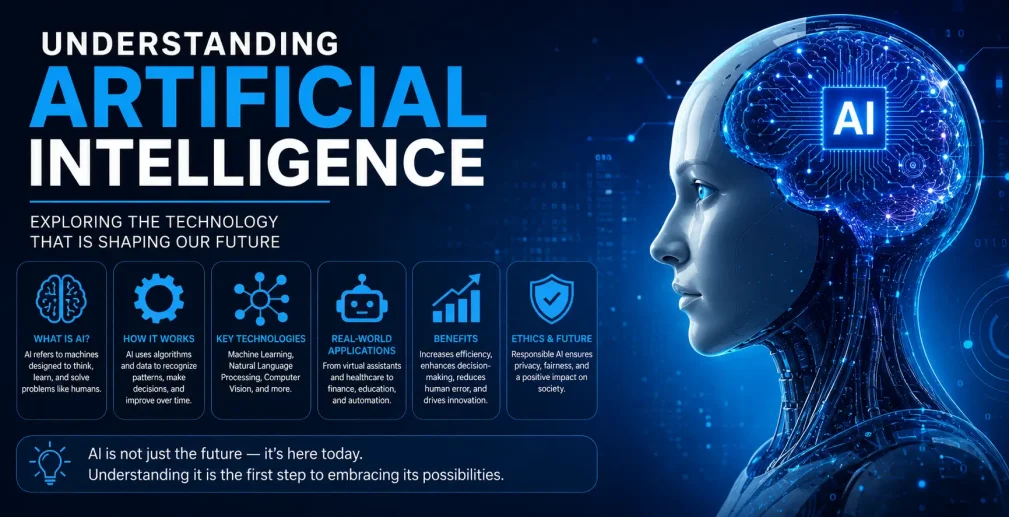
Artificial Intelligence is the ability of computer systems to perform tasks that normally require human intelligence. These tasks include learning from data, understanding language, recognizing images, making predictions, and solving complex problems.
Unlike traditional software that follows fixed rules, AI systems improve over time by learning from new information. This allows organizations to automate repetitive tasks while making smarter business decisions.
Today, AI powers everything from virtual assistants and recommendation engines to fraud detection systems and predictive maintenance solutions.
An Application Programming Interface (API) acts as a bridge between different software applications. Instead of manually transferring data from one system to another, APIs enable secure and automatic communication.
* An e-commerce website connects with a payment gateway through APIs.
* A mobile banking app retrieves account information using APIs.
* Delivery companies track shipments through API integrations.
* CRM software synchronizes customer information with marketing platforms using APIs.
* An e-commerce website connects with a payment gateway through APIs.
* A mobile banking app retrieves account information using APIs.
* Delivery companies track shipments through API integrations.
* CRM software synchronizes customer information with marketing platforms using APIs.
Individually, AI and APIs offer valuable capabilities. Together, they create intelligent digital ecosystems that automate decision-making and improve business operations.
APIs provide access to business data from multiple systems.
AI analyzes that data to identify trends, detect problems, and generate recommendations.
This creates faster workflows where information flows continuously while intelligent systems make real-time decisions without unnecessary delays.
The result is a smarter, faster, and more responsive organization.
Businesses often rely on multiple software platforms. AI-powered APIs eliminate manual data entry by automatically exchanging information between systems.
This saves valuable time while reducing operational bottlenecks.
AI continuously analyzes incoming business data through connected APIs.
Instead of waiting for reports at the end of the day, managers receive instant recommendations that help them respond quickly to changing business conditions.
Customers expect immediate responses and personalized services.
AI integrated with APIs can:
* Recommend products
* Answer customer questions
* Predict customer needs
* Personalize marketing campaigns
* Improve support response times
This creates a better overall customer journey.
Cybersecurity has become one of the biggest concerns for modern organizations.
* Unauthorized access attempts
* Suspicious login behavior
* Data theft
* Bot attacks
* Distributed Denial of Service (DDoS) attacks
This allows businesses to respond before security incidents become major problems.
Automation reduces repetitive manual work.
Employees spend less time performing routine tasks and more time focusing on strategic business activities.
This increases productivity while lowering operating costs.
Real-World Applications of AI and APIs
Intelligent Customer Support
Businesses now use AI chatbots connected through APIs to provide instant customer assistance.
These systems can:
* Answer common questions
* Track customer orders
* Schedule appointments
* Resolve technical issues
* Escalate complex cases to human agents
Customers receive faster service without waiting in long queues.
Predictive Maintenance
Manufacturing companies connect equipment sensors through APIs.
AI analyzes machine performance continuously and predicts when maintenance will be required.
This reduces equipment failures and minimizes production downtime.
Financial Fraud Detection
Banks process millions of transactions daily.
AI monitors transaction data received through APIs and detects unusual spending patterns.
Potential fraudulent activities are flagged immediately, protecting customers and financial institutions.
Healthcare Improvements
Hospitals use APIs to connect laboratory systems, patient records, appointment scheduling, and medical devices.
AI analyzes this information to assist doctors by:
* Identifying health risks
* Supporting diagnosis
* Predicting patient outcomes
* Recommending treatments
Healthcare becomes more efficient while improving patient care.
Retail Personalization
Online stores use APIs to gather customer browsing history, purchase behavior, and preferences.
AI processes this information to recommend products that match customer interests.
Personalized shopping experiences often lead to higher sales and improved customer loyalty.
AI-Powered API Security
As businesses become more connected, APIs handle massive amounts of sensitive information.
Traditional security systems often react only after an attack occurs.
AI introduces proactive protection by continuously learning normal API behavior.
When unusual activity appears, the system immediately alerts administrators or blocks suspicious requests.
This significantly reduces cybersecurity risks.
Cloud Computing Makes AI and APIs More Powerful
Cloud platforms provide the flexibility needed to scale AI-powered API solutions.
Businesses can:
* Increase computing resources during peak demand
* Store large volumes of business data
* Deploy applications globally
* Reduce infrastructure costs
* Improve system reliability